You are in: Readers, Things to print
Things to print
You can print all of these at home, for yourself or your reading group: bookmarks, a reading journal, cards with sayings from the book, chapter cards for each meeting, a map, a who’s who and the story of Wagadu. There are also sheets for a library or bookshop display. Every sheet fits A4 and US Letter paper.
On this page
Bookmarks
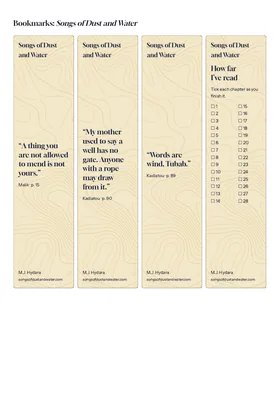
Four bookmarks to a sheet. Three carry a line from the book, and the fourth lists the chapters. One has Malik’s line about mending, from page 15, and two have lines of Kadiatou’s, from pages 89 and 90. Cut along the dashed lines.
Bookmarks: Songs of Dust and Water
“A thing you are not allowed to mend is not yours.”
Malik, page 15
“My mother used to say a well has no gate. Anyone with a rope may draw from it.”
Kadiatou, page 90
“Words are wind, Tubab.”
Kadiatou, page 89
How far I’ve read
Tick each chapter as you finish it.
Reading journal
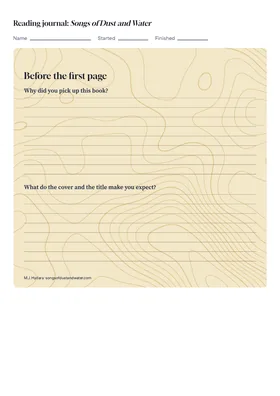
A page for each stage of your reading, with questions that give nothing away. The printed pages leave room for your answers. Keep them inside the book as you go.
Reading journal: Songs of Dust and Water
Name Started Finished
Before the first page
Why did you pick up this book?
What do the cover and the title make you expect?
M.J. Hydara · songsofdustandwater.com
Part One: The Glass House of the Sahel
Who in Madina would you go to for help, and why?
Write down a line you want to keep, and its page number.
Choose one character in Part One. What would you ask them?
M.J. Hydara · songsofdustandwater.com
The start of Part Two: “Ten years after the fire”
What has changed in ten years, and what has not?
M.J. Hydara · songsofdustandwater.com
Part Two: The Water-Keeper
Draw Nafawol, or describe it as you see it.
If you could give Nafawol one new rule, what would it be?
Write down another line you want to keep, and its page number.
M.J. Hydara · songsofdustandwater.com
After the last page
How did you feel when you reached the end?
Who would you pass this book on to? What would you tell them about it?
M.J. Hydara · songsofdustandwater.com
Sayings from the book
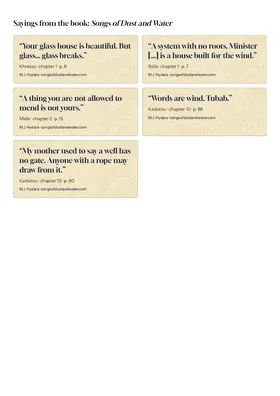
Lines from the novel, to print and cut out.
Sayings from the book: Songs of Dust and Water
“Your glass house is beautiful. But glass… glass breaks.”
Khresay, chapter 1, page 6
M.J. Hydara · songsofdustandwater.com
“A system with no roots, Minister […] is a house built for the wind.”
Balla, chapter 1, page 7
M.J. Hydara · songsofdustandwater.com
“A thing you are not allowed to mend is not yours.”
Malik, chapter 2, page 15
M.J. Hydara · songsofdustandwater.com
“Words are wind, Tubab.”
Kadiatou, chapter 10, page 89
M.J. Hydara · songsofdustandwater.com
“My mother used to say a well has no gate. Anyone with a rope may draw from it.”
Kadiatou, chapter 10, page 90
M.J. Hydara · songsofdustandwater.com
Hidden until you have read chapter 11.
“In ten years a heifer is a grandmother.”
Mamadou, chapter 11, page 97
M.J. Hydara · songsofdustandwater.com
Hidden until you have read chapter 16.
“A pot everyone can see into does not empty in the night.”
Isatou, chapter 16, page 130
M.J. Hydara · songsofdustandwater.com
Hidden until you have read chapter 17.
“If you let it be two when it is convenient, it will be two when it is not.”
The regulator’s inspector, chapter 17, page 136
M.J. Hydara · songsofdustandwater.com
Hidden until you have read chapter 28.
“A rope of four strands is not four ropes.”
Kadiatou, chapter 28, page 219
M.J. Hydara · songsofdustandwater.com
Chapter cards for a meeting
For each chapter, a line from the book and a question to talk over, as in the Companion. Print the cards for one meeting and cut them out.
Chapter cards: Songs of Dust and Water
Meeting 1: Part One, chapters 1 to 9
Hidden until you have read chapter 1.
Chapter 1: The Foundation
“That is the work. This thread of ours fed me, and it feeds you. It asks only for your hands.”
Ibrahim, page 3
To think over
Ibrahim and Talib see the loom in different ways. Have you ever been expected to carry on someone else’s work, or expected it of someone else? How did it turn out?
M.J. Hydara · songsofdustandwater.com
Hidden until you have read chapter 2.
Chapter 2: The Signature
“His signature tells you who held the pen”
Samba, page 17
To think over
Mustapha signs for the whole of Madina. Would you trust one person to sign for your street or your village? Who would it be?
M.J. Hydara · songsofdustandwater.com
Hidden until you have read chapter 3.
Chapter 3: The First Cracks
“They don’t get dirty, Mr Sterling. They choke.”
Aisha, page 24
To think over
Have you ever seen a good idea turned down because of where it came from?
M.J. Hydara · songsofdustandwater.com
Hidden until you have read chapter 4.
Chapter 4: The National Energy Fund
“Ebou, every foreign project in this country is an island with its own flag.”
Dunia, page 33
To think over
Dunia doesn’t trust projects run from abroad. Does she have a point, even if you dislike how she goes about it?
M.J. Hydara · songsofdustandwater.com
Hidden until you have read chapter 5.
Chapter 5: The Mechanical Rot
“Every warning. Every part. Every date. Keep a copy somewhere they cannot reach.”
Khresay, page 43
To think over
When you can’t stop something going wrong, what good does it do to write it all down?
M.J. Hydara · songsofdustandwater.com
Hidden until you have read chapter 6.
Chapter 6: The Human Rot
“The looms were still, and the children did not cry.”
The narrator, page 52
To think over
Have you ever gone along with an order you had doubts about? What made you do it?
M.J. Hydara · songsofdustandwater.com
Hidden until you have read chapter 7.
Chapter 7: Ash
“You sold us ash!”
Neneh, page 55
To think over
Neneh turns on Mustapha, not on Adam. Who, if anyone, do you think is most to blame for the fire?
M.J. Hydara · songsofdustandwater.com
Hidden until you have read chapter 8.
Chapter 8: The Scramble
“The worst of it was that none of the facts they read out were false.”
The narrator, page 61
To think over
Can a report be true in every line and still be unfair?
M.J. Hydara · songsofdustandwater.com
Hidden until you have read chapter 9.
Chapter 9: The Warp Thread
“Do not carry what is not yours to carry.”
Hawa, page 73
To think over
What do you think Hawa means? What is Talib carrying that isn’t his to carry, and what is his?
M.J. Hydara · songsofdustandwater.com
Chapter cards: Songs of Dust and Water
Meeting 2: “Ten years after the fire” and chapters 10 to 19
Hidden until you have read the start of Part Two.
Ten years after the fire
“The grandmothers called it a road that had not yet run out.”
The narrator, page 81
To think over
Some of Madina’s grandmothers still tell how the families of Wagadu followed the water south. Does your family, your town or a place you know have a story like that, of leaving one place for another? How is it told?
M.J. Hydara · songsofdustandwater.com
Hidden until you have read chapter 10.
Chapter 10: Words Are Wind
“My mother used to say a well has no gate. Anyone with a rope may draw from it.”
Kadiatou, page 90
To think over
Kadiatou worries about who will control the new machine. Is there something you depend on that someone else controls? What would change if you had the key?
M.J. Hydara · songsofdustandwater.com
Hidden until you have read chapter 11.
Chapter 11: The Taste of Nothing
“I didn’t choose a good man, Yaara-Jaxo. I chose a man who knows what it costs to be wrong.”
Dr Arramata, page 92
To think over
Dr Arramata chooses Adam because he has already been wrong, in public. What can a mistake made in public teach someone that nothing else can?
M.J. Hydara · songsofdustandwater.com
Hidden until you have read chapter 12.
Chapter 12: The First Furrow
“I thought I would be glad. I am glad.”
Kadiatou, page 99
To think over
Kadiatou has looked after the old well for years, and now the taps run. Why might good news bring her mixed feelings?
M.J. Hydara · songsofdustandwater.com
Hidden until you have read chapter 13.
Chapter 13: The Road of Hands
“Let it be a road of hands”
Kadiatou, page 110
To think over
What does a village gain by building its own road, instead of waiting for the government to do it? What does it risk?
M.J. Hydara · songsofdustandwater.com
Hidden until you have read chapter 14.
Chapter 14: The Shadow of Envy
“I only ask because I may have to buy a smaller truck, if nobody needs mine any more.”
The buyer’s agent, page 114
To think over
The cotton buyer’s agent smiles as he asks his question. What do you think he is really asking, and how would you answer him?
M.J. Hydara · songsofdustandwater.com
Hidden until you have read chapter 15.
Chapter 15: The Floodplain Guardians
“And you use them to chase our children into the stones.”
Alkalo Musa, page 122
To think over
Was Nafawol’s apology enough? What else could Nafawol have done?
M.J. Hydara · songsofdustandwater.com
Hidden until you have read chapter 16.
Chapter 16: Three Names
“A pot everyone can see into does not empty in the night.”
Isatou, page 130
To think over
Even Adam’s pay is on the village wall. If every shared fund where you live put its accounts up for all to read, what would change?
M.J. Hydara · songsofdustandwater.com
Hidden until you have read chapter 17.
Chapter 17: The Two Lines
“If you let it be two when it is convenient, it will be two when it is not.”
The regulator’s inspector, page 136
To think over
A payment for the stone that the culvert needed had only two of the three signatures. Is the inspector right not to let it pass? Have you ever seen a small exception become the rule?
M.J. Hydara · songsofdustandwater.com
Hidden until you have read chapter 18.
Chapter 18: The Mill
“I have read four hundred. Do not tell me about groundnuts.”
Fatou, page 139
To think over
Fatou has just said that Kadiatou’s grandfather could not read a contract. Was that fair? Why do you think Kadiatou doesn’t argue back?
M.J. Hydara · songsofdustandwater.com
Hidden until you have read chapter 19.
Chapter 19: The House of Knowledge
“A strike does not always reach it. Sometimes it only burns out the protection in front of it.”
Bintu, page 149
To think over
Dr Arramata could have fixed the fault herself. Has anyone ever held back so that you could work something out on your own? What did it teach you?
M.J. Hydara · songsofdustandwater.com
Chapter cards: Songs of Dust and Water
Meeting 3: chapters 20 to 28
Hidden until you have read chapter 20.
Chapter 20: The Blueprint Spreads
“This village did not fail. It was stopped.”
Nyma, page 159
To think over
Where would you draw the line between a village that fails and one that is stopped? Was Nafawol right to carry the cost?
M.J. Hydara · songsofdustandwater.com
Hidden until you have read chapter 21.
Chapter 21: The Senebian Economic Union
“Why does the carter always stop just under the line?”
Mariam, page 164
To think over
Mariam spots what the adults have missed. Who checks the public accounts in your town, and could a child do it?
M.J. Hydara · songsofdustandwater.com
Hidden until you have read chapter 22.
Chapter 22: Six and Four
“And I sound just as sure when I’m wrong as when I’m right.”
Hassan, page 172
To think over
When everyone is waiting for your answer, what does it take to go and listen first?
M.J. Hydara · songsofdustandwater.com
Hidden until you have read chapter 23.
Chapter 23: The Offer
“Anyone can copy the charter on your academy wall. Nobody else can deliver your crop.”
Evelyn Reed, page 181
To think over
What do you think Veldane is really trying to buy with its offer?
M.J. Hydara · songsofdustandwater.com
Hidden until you have read chapter 24.
Chapter 24: Perpetuity
“Fifty thousand is not a word to me. It is rest. It is medicine.”
Demba’s father, page 184
To think over
Demba and his father disagree about the offer. Which of them do you understand better, and why?
M.J. Hydara · songsofdustandwater.com
Hidden until you have read chapter 25.
Chapter 25: The Vote
“We have not delivered a child by torchlight in years”
Hawa, page 197
To think over
Whatever else Dunia did, Hawa gives her credit for the grid. Can someone do real harm and real good in the same job? How would you weigh the two?
M.J. Hydara · songsofdustandwater.com
Hidden until you have read chapter 26.
Chapter 26: A Sower and the Soil
“It was always ours. This is only the receipt.”
Fatou, page 207
To think over
When does a thing become yours: when you build it, when you pay for it or when the papers say so?
M.J. Hydara · songsofdustandwater.com
Hidden until you have read chapter 27.
Chapter 27: The Second Song
“It’s paid for”
Hawa, page 214
To think over
Hawa could have told the mother the cloth was free. Why do you think she says it is paid for?
M.J. Hydara · songsofdustandwater.com
Hidden until you have read chapter 28.
Chapter 28: The Water-Keepers
“We have never agreed about it.”
Kadiatou, page 220
To think over
Years after the vote, Kadiatou and Fatou still disagree about Veldane’s offer, yet they are close friends. What keeps a friendship going through a disagreement that never ends?
M.J. Hydara · songsofdustandwater.com
If you run a reading group and haven’t read this far yourself, you can open this meeting’s cards now and print them.
A map of the two countries
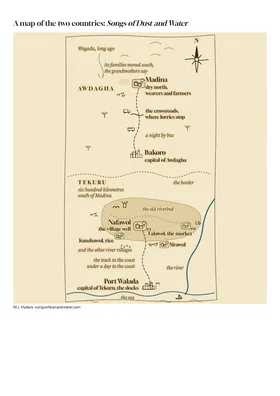
A rough sketch, not to scale, to keep beside the book.
A map of the two countries: Songs of Dust and Water
An old-style sketch map, with north at the top. Furthest north is Wagadu, the old empire in the grandmothers’ stories. Its families followed the water south. In Awdagha, Madina lies in the dry north, with a crossroads below it where lorries stop. Bakoro, the capital, is a night’s bus ride to the south. Then comes the border. Nafawol lies six hundred kilometres south of Madina, in Tekuru, on an old floodplain beside a dry riverbed. Close around it are other river villages, among them Sirawol, Kumbawol with its rice, and Talawol with its market. A river winds down to the sea, and a track runs south from Nafawol to Port Walada, Tekuru’s capital on the coast, less than a day away. The villages are drawn as walled compounds of cement-block houses with shade trees, and the two capitals as clusters of buildings, with a crane at the port. Along the way are fields, goats, a lorry at the crossroads, the night bus, a donkey cart, a lorry at the Talawol market, a baobab, acacias and a boat on the sea.
M.J. Hydara · songsofdustandwater.com
Who’s who
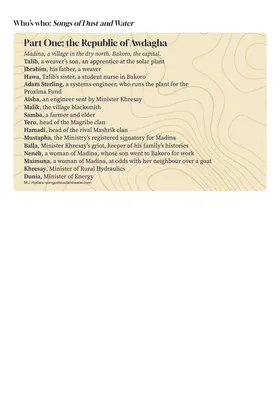
The book’s own list of characters, a page for each part.
Who’s who: Songs of Dust and Water
Part One: the Republic of Awdagha
Madina, a village in the dry north. Bakoro, the capital.
Talib, a weaver’s son, an apprentice at the solar plant
Ibrahim, his father, a weaver
Hawa, Talib’s sister, a student nurse in Bakoro
Adam Sterling, a systems engineer, who runs the plant for the Proxima Fund
Mark, his director at Proxima
Aisha, an engineer sent by Minister Khresay
Malik, the village blacksmith
Samba, a farmer and elder
Yero, head of the Magribe clan
Hamadi, head of the rival Mashrik clan
Mustapha, the Ministry’s registered signatory for Madina
Balla, Minister Khresay’s griot, keeper of his family’s histories
Neneh, a woman of Madina, whose son went to Bakoro for work
Maimuna, a woman of Madina, at odds with her neighbour over a goat
Khresay, Minister of Rural Hydraulics
Dunia, Minister of Energy
Yusuf Dunia, her brother, a banker
Ebou, Minister of Finance
Nabil, Deputy Administrator of the National Energy Fund
M.J. Hydara · songsofdustandwater.com
Part Two: the Republic of Tekuru, ten years later and six hundred kilometres south
Hidden until you have read the start of Part Two.
Nafawol, a village on a floodplain the river has abandoned. Its neighbours Sirawol and Talawol, Talawol and Kumbawol. Kerewol, which joins the Union later. Port Walada, the capital.
Kadiatou, the Yaara-Jaxo, or Water-Keeper, of Nafawol
Mariam, her granddaughter
Jainaba, Mariam’s elder sister
Halima, Jainaba’s daughter, Kadiatou’s great-granddaughter
Sankung, alkalo of Nafawol
Mamadou, an elder of the village
Lamin, Mamadou’s grandson
Ousman, a farmer and elder, who takes up Dr Arramata’s challenge in the test fields
Bakary, a master weaver
Fatou, a trader, who keeps Nafawol’s accounts and later the Union’s
Isatou, head of the women’s kafo, who runs its osusu
Haja, a widow of Nafawol, and the eldest woman in the osusu
Hassan, a young welder of Nafawol, who becomes the Union’s technical lead
Nyma, a mill operator
Edrisa, a builder, who leads the road crews and the Guardians
Alie, a senior technician
Demba, a young road-builder
Fanta, a weaver
Saikou, a young labourer on Edrisa’s crew
Dawda, a small boy of Nafawol
Bintu, a student of the academy, who later takes over the Union’s technical work from Hassan
Dr Arramata, Proxima’s engineer, born in Nafawol
Adam Sterling, the Tubab, the systems engineer of Part One, who comes with Dr Arramata
Musa, alkalo of Sirawol
Yaya, alkalo of Kumbawol
Jankero, an elder of Kumbawol
Aminatu, a young delegate from Talawol
The Teranu, a family of Nafawol, whose compound is by the east channel
Sulayman, Minister of Rural Development
Evelyn Reed, a businesswoman with Veldane Agriculture
M.J. Hydara · songsofdustandwater.com
Wagadu and the snake in the well
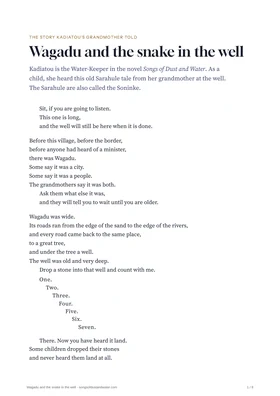
The story that Kadiatou, the Water-Keeper, heard from her grandmother at the well. Read aloud, it takes about nine minutes, which suits the start or end of a reading-group meeting. You can read it on the site before you print it.
For a library or bookshop display
Two sheets about the book and a page of shelf cards, for anyone putting it on display. Each has a QR code that opens this website.
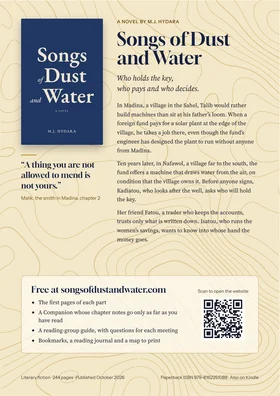
About the book
One page for readers browsing the display: a short outline of the story and Malik’s line about mending.
Download the sheet about the book (PDF, A4, 1 page) US Letter size (PDF)
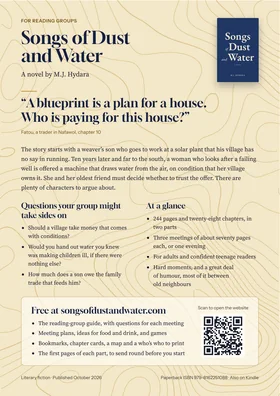
For reading groups
One page for a noticeboard or a reading-group table, with questions a group might take sides on.
Download the sheet for reading groups (PDF, A4, 1 page) US Letter size (PDF)
Shelf cards
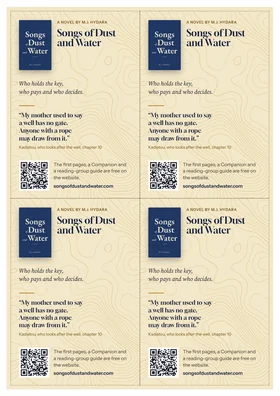
Four cards to a page, to stand beside the book, with Kadiatou’s line about the well. Print them on thin card if you can, and cut along the dashed lines.
Download the shelf cards (PDF, A4, 1 page) US Letter size (PDF)